
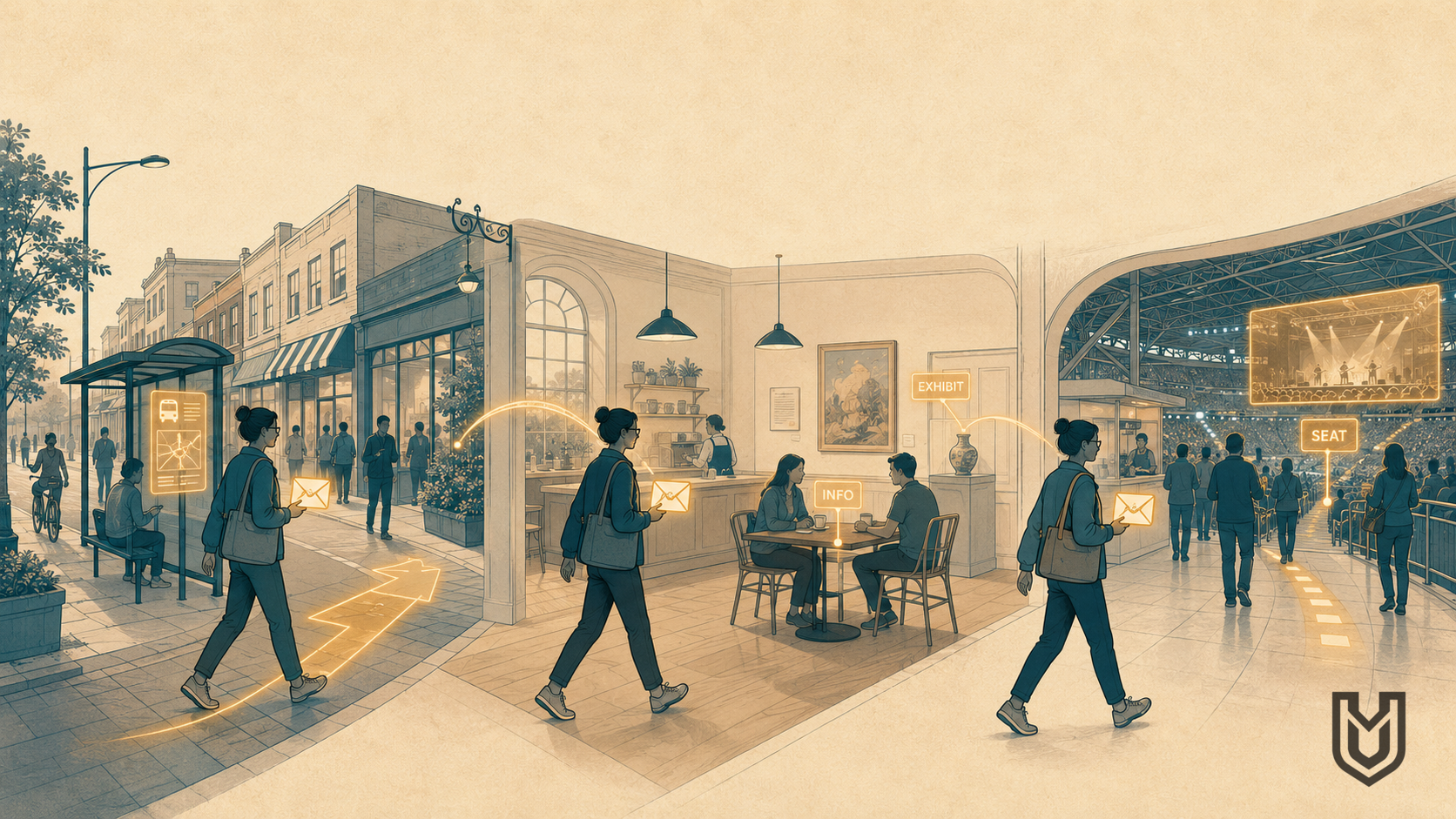
Where Universal Manifest Sits in Spatial Computing
Spatial computing layers many provider-run environments over the same physical world. Universal Manifest is the portable identity and consent envelope that persists across all of them, so you carry one self through overlapping fabrics instead of cold-starting each one.
Spatial computing does not give you one world to live in. It gives you many, layered over the same physical space, each run by a different provider. A retail fabric covers one block. A transit fabric covers the station. A venue fabric covers the concert hall. Walk a city in AR glasses and you are inside several of these at once, and crossing in and out of others every few steps.
That is the shape of the problem. The basics of how a single crossing works are covered elsewhere; this is the wider picture. If every fabric you enter is a fresh account and a fresh consent flow, the spatial internet is unusable at walking speed. Something has to be the one self that persists across all of them. Universal Manifest is built to be that thing.
One self across overlapping fabrics
A spatial fabric is a provider-defined environment: a coordinate space, a set of services running inside it, a policy about who may enter and what they may do. Fabrics overlap. They do not share a backend, an account system, or a consent model. Each one is its own boundary.
Universal Manifest treats that as the normal case rather than the exception. You hold one signed envelope that carries your identity, your consent positions, and your verifiable credentials. Your client presents it to each fabric as you come into range, and each fabric receives only the projection its role is authorized to see. The retail fabric reads your location consent. The safety service reads your safety credentials. The age-gated venue reads a proof that you clear its threshold and nothing more. One envelope, many scoped projections, no fabric learning more than its role allows.
Because the envelope persists, your consent positions are not something you re-declare per fabric. You set them once. They are a structural property of the credential you carry, enforced at every boundary you cross, whether that boundary is between two fabrics, between a fabric and a physical location, or between two services inside the same fabric.
Where the manifest sits in the architecture
Published spatial-computing browser architectures describe a layered model. A client connects to fabrics through a service protocol, caches the user’s credentials locally, and presents them to services automatically as the user moves through the world. These architectures call for a portable credential the client can cache and present. They have not standardized the format that credential should take.
Universal Manifest is designed to occupy exactly that slot. A signed envelope carrying identity, consents, and verifiable credentials fits the credential layer the architecture already assumes. The client holds the envelope. The fabric reads it. The services receive only what their role authorizes. The audit trail records what happened. None of those pieces requires the architecture to bend, because the architecture already described the gap the envelope fills.
Three needs that recur across the spatial-computing stack map onto what the manifest already carries:
- Identity at every service boundary. A fabric needs to know who is entering and what kind of entity they are: a person, an AI agent, or a scripted character. The manifest carries that, signed by the issuer, so the fabric verifies a signature instead of running an account-creation form.
- Consent that holds across services. AR and VR expose sensitive sensor data: eye tracking, hand tracking, room geometry, camera passthrough. The manifest carries a consent position for each category, declared once and enforced at every service inside every fabric, rather than a dialog repeated at each transition.
- Trust in the code that runs the fabric. Services inside a fabric run in sandboxes and do not trust each other by default. Code modules can carry a signed attestation binding the code to a verified publisher, with a revocation check before execution, and services that must message across sandbox boundaries can declare which messages are permitted between which services. The manifest provides the verifiable claim; the fabric enforces it.
The architecture moves you; the manifest is who arrives
A transport protocol decides how you cross from one fabric to the next: coordinate mapping, scene loading, connection handoff. Universal Manifest does not replace that, and it is not trying to be the spatial layer. The transport moves you through the world. The manifest is the identity and consent that arrives when you get there.
That division is what lets one self scale across a fabric ecosystem that no single provider controls. The fabrics keep defining their own spaces and policies. The transport keeps moving people between them. The manifest stays consistent underneath, the portable layer the rest of the stack assumed but left unspecified.
Read the full RP1 Spatial Fabric use case. See how Universal Manifest composes with existing standards. Read the spec.