
Platform Portaling: Stepping Through With Your Identity Intact
Portaling means crossing from one platform or world into another with your identity, permissions, and context intact. Here is what happens at the boundary, and why each receiver gets only the version of you it needs.
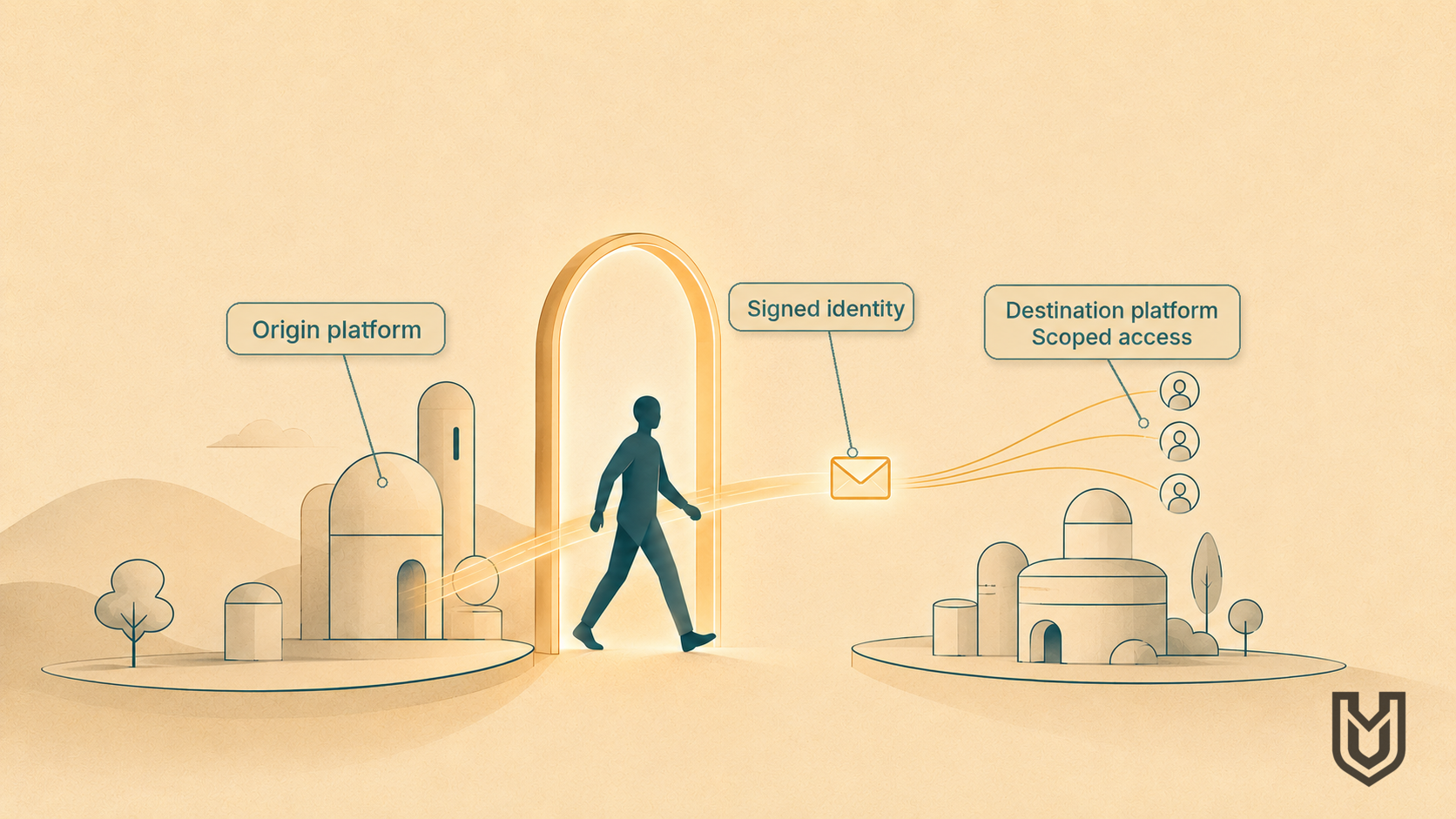
Portaling means crossing from one platform or world into another with your identity, permissions, and context intact. A friend invites you into a world your account does not exist in. You step toward the boundary, and the version of you that travels arrives before your avatar does.
Today that crossing is a cold start. New world, new account, new avatar, re-grant the permissions, re-claim a persona that maps to nothing the destination can verify. Every threshold is friction. Universal Manifest changes what happens at the threshold: your client sends your signed manifest ahead of you, the destination reads it, and you are recognized without being onboarded.
What happens at the boundary
A portal is a boundary between two platforms, and a boundary is where a manifest gets evaluated. Your client emits your manifest as you approach. The destination publishes its own in return: the operator’s identity, the content rating it enforces, the credentials it requires for entry, the services running inside it, the consent positions it asks visitors to set. Both sides declare their terms before the crossing begins.
Then the evaluation sequence runs, in order, every time:
- Arrive. Your manifest meets the boundary. The destination receives the signed envelope and the terms you are presenting.
- Verify. The destination resolves your identifier, retrieves your public key, and checks the signature over the manifest. It confirms the envelope has not been tampered with and has not expired. It reads your entity type (human, AI agent, or scripted character) and confirms the claim is signed by an issuer it trusts.
- Project. The destination identifies its own role and applies the projection rule for that role. It receives the subset of your manifest that role is authorized to see, and nothing outside it.
- Consent. The destination reads your consent positions and enforces them. Eye tracking denied stays denied at every service inside the world. Hand tracking granted means gesture input works. The rules are structural, set once, applied at every boundary, not a pop-up repeated at every transition.
- Compose. The destination has what it needs to render you. It reads your avatar’s parametric definition and generates the mesh locally, applies your height and language and accessibility settings, and grants you presence.
- Receipt. Both sides write a signed record of what happened: what was verified, what was projected, what consent applied, which fields stayed sealed. The next time you portal, the receipt chain extends.
A world that respects the manifest welcomes you without onboarding you. A world that cannot read it can still run a presence check without learning anything the manifest did not authorize.
Each receiver gets a different version of you
What travels in the manifest depends on what the destination needs, and the manifest carries the rule for that, not just the data.
A retail world gets your persona and your consent positions for location sharing and hand tracking. An age-restricted venue gets a proof that you are old enough to enter, with no name, no birth date, and no government ID attached. An accessibility-aware world gets your input modality, your captioning settings, and your sensory-load limits, so it can configure itself before you arrive. Your root identity, your full birth date, and your unrelated credentials stay sealed: present in the envelope, but opaque to a receiver that is not authorized to read them.
Each receiver gets a scoped projection. A different visitor crossing the same threshold gets a different projection, because their manifest defines their own rules. You do not hand over everything to everyone, and the destination cannot quietly take more than its role allows. If it skips a check, it has to say so on the receipt.
The manifest moves the identity, not the body
Portaling between worlds also needs a transport: something that maps coordinates, loads the scene, and hands off the connection. Standards like the Inter-World Portaling Standard (IWPS) are built to handle that spatial mechanics of the crossing.
Universal Manifest does not replace the transport. It sits alongside it. The transport decides where you go and how the visual transition renders. The manifest decides who you are and what you have consented to. The transport moves the body; the manifest moves the identity.
That separation matters because your identity and consent rules do not change based on which protocol carried you there. Whether the crossing uses IWPS, a direct connection, or a protocol that does not exist yet, the destination still needs a signed envelope to verify against. The manifest is built to be that envelope.
Try it in the sandbox
The Universal Manifest sandbox includes two scenarios that walk a portal crossing step by step:
- IL-03: Cross-World Identity shows how a manifest is presented, validated, and projected when a visitor portals into a destination world, with consent positions checked per feature.
- IL-04: Spatial Fabric Anchoring shows how a destination validates spatial anchors, checks freshness, and enforces session-context safety.
Both run in the browser against real manifest fixtures.
Read the full Portaling Between Virtual Worlds use case. See how the evaluation sequence works. Read the spec.